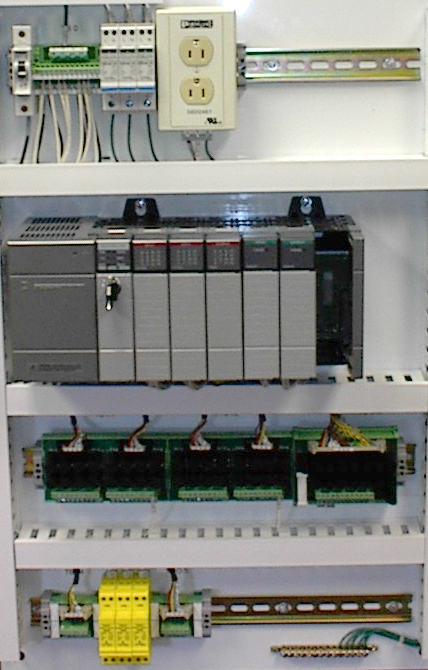
Production Line Automation
Coordinate conveyors, stations, machines, sensors and actuators using programmed sequences and equipment-to-equipment communication.
Image: Tecnowey / Wikimedia Commons · CC BY-SA 3.0
SATECXA develops industrial manufacturing solutions that combine electrical engineering, automation, machine control, industrial networking and production monitoring into practical systems.
Modern manufacturing depends on coordinated control between field devices, controllers, drives, operator interfaces and production information. SATECXA can structure these elements around the actual machine or production process.
Coordinate conveyors, stations, machines, sensors and actuators using programmed sequences and equipment-to-equipment communication.
Image: Tecnowey / Wikimedia Commons · CC BY-SA 3.0
Build machine logic around I/O, sequences, interlocks, alarms, motor control, operator commands and process conditions.
Image: Dailynetworks / Wikimedia Commons · Public domain
Our manufacturing scope can cover an individual machine, an automated production cell, a complete production line or a plant monitoring system.
Automation systems for machines, production equipment and manufacturing lines using PLCs, HMIs, drives, sensors and industrial communication.
Control architecture and software for machine sequences, interlocks, motor control, alarms, operator interfaces and production cycles.
Integration of conveyors, machines, stations and auxiliary systems so equipment can exchange commands, status and process information.
Control-panel engineering, field I/O, electrical control architecture and wiring coordination for industrial machinery and plants.
Supervisory monitoring systems for real-time process visibility, alarms, trends, reports and production information.
Modernization of existing machines and legacy control systems through new PLCs, HMIs, drives, communication and monitoring.
A typical automated manufacturing system moves information and control through several connected layers.
Sensors, switches, encoders and instruments collect process information.
The controller executes machine logic and sequences.
VFDs, servos, motors and actuators perform the required actions.
Operators monitor status, change settings and respond to alarms.
Supervisory systems collect process data, alarms, trends and reports.
The complete system supports the defined manufacturing cycle.
Automation requirements vary by process, machine type, production rate and operating environment.
Control, monitoring, electrical integration and automation solutions can be structured around the application.
Control, monitoring, electrical integration and automation solutions can be structured around the application.
Control, monitoring, electrical integration and automation solutions can be structured around the application.
Control, monitoring, electrical integration and automation solutions can be structured around the application.
Control, monitoring, electrical integration and automation solutions can be structured around the application.
Control, monitoring, electrical integration and automation solutions can be structured around the application.
Control, monitoring, electrical integration and automation solutions can be structured around the application.
Control, monitoring, electrical integration and automation solutions can be structured around the application.
Review the detailed capabilities page for machine automation, control systems, production-line integration, electrical engineering and modernization work.
Share your machine details, production process, existing controls or automation requirements and start a technical discussion.